Long ago (1988) I moved to Berkeley and started sending a monthly "newsletter" to my Boston friends. When I returned to Boston (1993), I continued the tradition for about five more years (or until I had kids). Looking back, I realize that I was actually blogging. Each newsletter contained anywhere from a few to several blog posts. Having been silent for the past decade or so, I've decided to resume these activities. Don't expect anything profound -- I tend to focus on what I find entertaining or amusing and perhaps sometimes informative. We shall see!

Tuesday, July 4, 2017

Into Africa: Walter Sisulu Botanical Garden

It is our first day in South Africa, and we are all a bit punchy, tired, jet-lagged, and extremely excited! The decision for a relatively short outdoor adventure with the potential for a bit of a hike was the perfect way to get us started.

I have to admit it -- I was a bit surprised to see that there was a suggested reading list for this trip. But, I wanted to be a good doobee, so I read the short Mandela book recommended for the students and then dove into the rather long, "Long Walk to Freedom," Mandela's autobiography. I am so glad I did! It let me put many things into historical context and more fully appreciate everything we saw. For example, when we landed at OR Tambo International Airport in Johannesburg, I knew who Oliver Tambo was. And when we visited the Walter Sisulu Botanical Garden, I knew who he was too.

The botanical gardens was our first real introduction to South Africa and it reminded many of us of southern California in its fauna. The highlight for our crew was a beautiful waterfall and the hiking trail that led to the top of it.

Some spotted the black eagles that had been advertised, but I missed them. I had to settle for guinea fowl!

Back to Main Page

Into Africa: The Kliptown Youth Program


Monday

Our trip leader, Pete Johannsen, is on the board of the Kliptown Youth Program, whose motto is, "From Poverty to Opportunity," which seems perfectly appropriate. Started by a group of young men who grew up in Kliptown, KYP provides tutoring, arts classes, and a sense of community, for some of the youth of Kliptown.

Note: The terms below are the terms that were used during Apartheid and are still used today when describing the past and present.

Let's back up a bit. Under Apartheid, people were removed from their homes and relocated to ethnic townships -- Africans (Bantu) in one, Indians in another, Coloureds (mixed race) in a third. The townships were supposed to be separate, but equal, but in practice were most definitely separate and unequal. Soweto is a large, predominantly (98%+) black township, officially part of Johannesburg, but nearly an hour outside of the city center. Today it is a thriving city, composed of many different neighborhoods. Some are extraordinarily wealthy, while others are devastatingly impoverished. Kliptown is among the most impoverished -- unemployment is at nearly 80%.

KYP helps children succeed in school -- somewhere between 80 and 90% of the KYP students who take their "matrics", the exams that let you graduate high school, pass. Several go on to university. The alumni remain engaged in the program.

As we enter the KYP facility, we are given the most amazing welcome -- children and staff line the walkway and sing enthusiastically as we arrive.


Everyone on our trip had been given paired with a "penpal" from KYP -- mine was Xoli (pronounced Ko-li, with a distinctive Xhosa click that I can pretty much replicate, but it took work), who manages the IT services at KYP. Xoli wasn't around on Monday, so I didn't get a chance to meet him until Wednesday.

Most of the students and staff at KYP speak at least three languages and sometimes four or more. Everyone speaks English. I believe some also speak Afrikaan. The default language of the area is isiZulu. There are also a fair number of folks whose native language is isiXhosa (pronounced click/Cl-oh-za). As South Africa has eleven official languages, I'm willing to bet there are instances of every language in the community. Everyone easily transitions between the different languages -- it is humbling to experience.

Our introduction took place in one of the classrooms, where a few of the students introduced themselves to us, told us how old they were, what they were studying and what jobs they were planning on doing when they graduated. Then, we were treated to a performance of the gumboot dancers -- absolutely amazing! The leader of this program is one of the KYP founders, Thando -- a gifted singer, dancer, and actor with more energy, passion, and enthusiasm than any four middle school students, is clearly an inspiration to all who know him!


Wednesday

We met up with our penpals on Wednesday at the Apartheid museum and then together, we all headed back to KYP.
Xoli is 26 and is himself a graduate of KYP. He grew up in Kliptown and for awhile had an apartment outside of Kliptown and was working in finance. However, in his words, at some point he had to choose between money and happiness, and he chose happiness, moved back to Kliptown, and joined the staff of KYP. He has also started a record label and wants to run a restaurant.

 In addition to teaching basic computer literacy and programming to the kids of KYP, he offers computer literacy courses for the adults of Kliptown. If any Microsoft folks are reading this and have access -- they are running Office 2007 at KYP -- I'm sure they would love donations of more recent software! (Although, we should probably make sure that their hardware infrastructure is capable of running newer versions -- they have a computer room with a bunch of PCs, a large collection of XO's, and a new set of 20 chromebooks.)

There were two major activities that afternoon -- an art project and home visits. The art project, led by Meadowbrook teachers Caroline Kurman, Roseanne Beard, and Kerstin Johnson, was an identity project, designed to give the students a chance to get to know each other better in a non-threatening manner. The basic idea is that each of several colors represent different aspects of what helps us create our identity: family, friends, education, interests, gender, culture, and the things we "have". The students were all provided with lots of colored paper, scissors, and glue and asked to create a picture that showed who they were.

It was fascinating to see the pictures emerge -- as I walked around the room the pictures told stories of each student. I'm enclosing some sample pictures and then the "quilt" created by all the images. I encourage you to look carefully at the ensemble of pictures and see if you can guess which colors corresponded to which of the themes mentioned above. (I've put the color key at the bottom of the page.
After the art project, the KYP students who lived nearby took their penpals (and the penpals of other who lived further away) to their homes. I accompanied two groups of students whose KYP students lived close to each other. I'm struggling to find the right words to capture this experience. Suffice it to say that all of us were deeply moved by how little space it takes to make a structure a home. Upon reflection later, practically everyone commented on the importance of positivity over material possession; we all took inspiration from our new friends' attitude and strength.

We spent much of Thursday with our penpals outside of KYP, so that's reported on elsewhere. I'll wrap up with our last day at KYP.

Friday

In preparation for the trip, each Meadowbrook student in grades K-5 had selected their favorite book and then purchased a new copy to send with us. Each of those books had a book plate identifying the student who had selected the book. In addition, families donated piles of other books, and yours truly brought a pile of programming books -- HTML, CSS, Javascript, Python, etc. Three of the books I ordered had not arrived when I left, so I'll probably be shipping more books off -- if you have books you think might be appropriate, let me know!


For the book project, Ms. Kurman had photographed each student holding his/her favorite book and turned it into a short video. We took groups of kids to see the video and then let them select a book and wander off to the library to read with our students.

Then it was time for the beginning of the end -- Friday afternoons are arts and sports time -- a bunch of Meadowbrook and KYP students played netball, other students were in dance classes and/or drumming classes. Then everyone gathered around for some group singing,


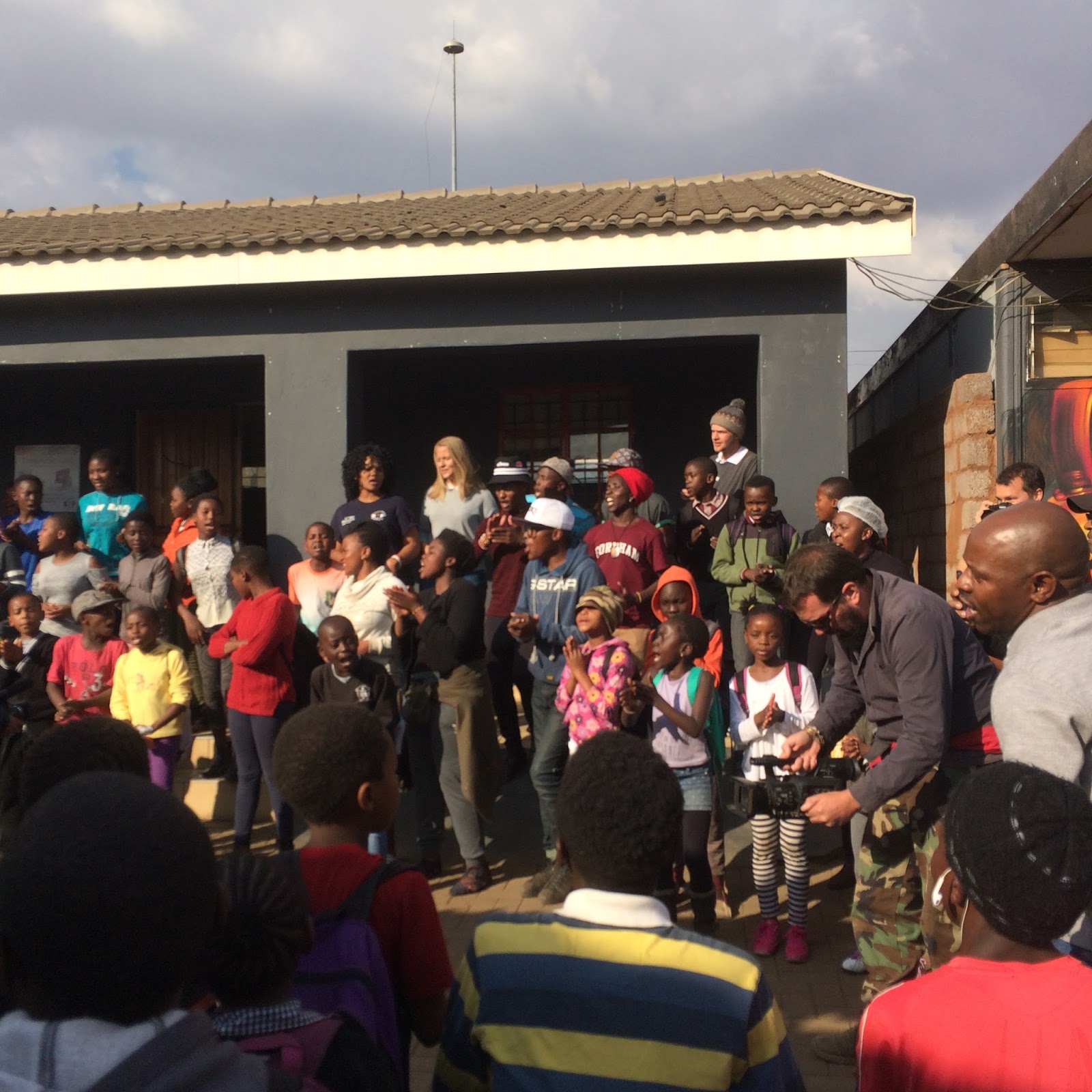
and this led to an exit, to mirror our entrance -- everyone lined the walkway and sang and clapped and danced as we all walked out with our penpals. Then something truly remarkable happened (and Pete said he'd never seen this happen before): the entire KYP community followed us out to our bus, singing the entire way.


The hugs and tears and waves and high fives and joyous singing are undoubtedly the strongest memory I have of this trip. I don't think there was a dry eye on the bus as we drove away.

Color key


  • Black: Family
  • Purple: Friends
  • Blue: Education
  • Yellow: Culture
  • Green: Interests
  • Red: Gender
  • Orange: Stuff
Back to Main Page

Into Africa: Into the Bush


It is our first day on Safari in South Africa at Madikwe game reserve, and it's been incredible. The day started before our first official Safari -- our bus took us only as far as a dirt landing strip where we unloaded and split up into three Safari vehicles and a fourth truck to haul all the luggage.

We were originally scheduled to stay at Tau Lodge, but they had a fire last Wednesday (June 14), so there was some scrambling to find alternate accommodation. Fortunately, the different lodges in the park seem to get along pretty well and we were able to get accommodation at Jaci's and we have been pampered by the joint team from both Jaci's and Tau.

Anyway, back to the animals! We had about an hour drive from the airstrip to the lodge. Along the way we saw: a large, oldish male giraffe, who ambled across the road in front of us.

Next up was an elephant and lots and lots of impala (pictures later in the stay).


Then we approached Jaci's watering hole and came upon dozens of elephants -- large, small, medium-sized -- it was unbelievably amazing.

We arrived at the lodge with barely enough time to get a brief orientation, eat lunch, stop by our rooms, and head out on our first real safari drive. I was staying in a place called the Tree Lodge, which consists of a central lodge and then long elevated wooden walkways to individual bungalows. Each bungalow has it's own building with a deck and outdoor shower. The rooms were enormous and included a HUGE bathtub.

The safari drives are three hours in total: about an hour and a half, followed by a stop and snack, followed by a final hour. I don't know if this is true at all lodges, but Jaci's does not believe in letting you go hungry -- I feel a bit like a hobbit. Before our 6:30 AM game drive, we will be given first breakfast (coffee, tea, muffins, toast, oatmeal). We will then have a snack in the middle of the safari ride. We return to the lodge for second breakfast (eggs, bacon, fruit, sausage, yogurt, etc.) Most people then have to tough it out until high tea at 3:00, but we are special -- we have a post-breakfast activity (tomorrow we're learning about elephant conservation) followed by a full lunch. We then repeat the safari ride and snack combination in the afternoon/evening and return for a full dinner. And while I've been pretty good so far at sticking to meat and vegetables, the folks here have baked me homemade gluten free bread and made me gluten free pasta. I kind of feel like I have to eat it. I was all ready to skip dessert this evening and they brought me a special dessert (which I managed to pawn off on a friend).

Once again -- back to the (non-primate) animals (although we've been warmed about monkeys in our rooms if we're not careful). Heading out on our safari drive, we once again stopped by the elephants at the watering hole on the way out. There were fewer of them, but some more interesting specimens. My favorite was the nursing baby elephant. And I would be remiss not mentioning the exceedingly horny male elephant who was checking out all the girls.


Then was saw lots and lots more impala, whose backsides seem to have M's on them. The local joke is that it stand for "McDonald's". Impala are the most plentiful antelope, and everyone eats them! Personally, I think the M stands for "mmmmmm".

We saw some gorgeous birds, including the lilac breasted roller who has spectaular bright blue wings (but is relatively small and difficult to photograph) and the yellow bill hornbill (aka Zazu bird).

By then it was almost sunset and it was snack time. After snack, we started the nighttime adventure -- the driver scans with a spotlight while driving. We saw more elephants, some zebra, a (small) warthog, a few bunnies, more impala. One of our cars (not ours) also saw a water buffalo! By this time it was also quite cold, but fortunately we'd been told to layer up and they provided us blankets in the open-air safari vehicles. And so ends day 1 -- can't wait to see what tomorrow holds.
Sunday Safari
Monday Safari
Tuesday Safari
Leaving on Wednesday
Back to Main Page

Friday, June 30, 2017

Into Africa

From June 17 until July 3, I had the privilege of visiting South Africa with The Meadowbrook School of Weston. They do a semi-annual trip, under the guidance of Peter Johannsen, who is on the board of an incredible organization called the Kliptown Youth Program. Although I had no children on the trip, as an alumni parent, they welcomed me on the trip with open arms, for which I was and remain truly grateful. So, at the crack of pre-dawn, 15 Meadowbrook students, two Beacon Academy students, five Meadowbrook teachers, three current parents, the headmaster of Beacon Academy, and I set off on the trip of a lifetime.

It will take me quite awhile to write up all the different parts of the adventure, so I'll be populating the links below as I complete the various writeups. I'll leave the links for not-yet-written pages red. If you would like to see the full picture collection (without words), send me email and I'll send you a login/password for the web site (once it's up, which will also take a bit).

Our adventure started in Johannesburg, or "Jo-burg," hitting the ground almost 24 hours after we left (we flew through Heathrow).

  Once there, we met Pete's Aunt Chris and Uncle Nick (Chris and Pete have been managing this trip since its inception) who helped us find ATMs and our bus. There we met our driver Niels, who quickly became part of the family (more on this later). We headed to the Hertford, which would be our home base for the first week. After a hearty lunch, we headed out to the Walter Sisulu Botanical Garden. It was precisely the right activity to keep jet-lagged travelers awake, provide fresh air, and burn off some of the pent-up energy that was stifled on two long plane flights.

Day two (Monday, June 19) started with a tour of Soweto, one of the old African townships of apartheid days, and now home to roughly 2.5 million people, almost all African, and a visit to a local elementary school, the Florida Avenue School. After lunch, we headed to Kliptown to meet the penpals from the Kliptown Youth Program (KYP) with whom we'd all been corresponding.

Day three (Tuesday, June 20) was a tourist day (KYP students were writing exams the week we were there, so our schedule was closely tied to their availability): The Elephant Santuary, The Cheetah Reserve, and The Carnivore Restaurant,
where we dined on the likes of Kudu and Impala (both species of antelope), Zebra (I heard this was the best, but couldn't bring myself to try it), and Crocodile (I also passed on this).
 
Day four (Wednesday, June 21) we visited the The Apartheid Museum where (no pictures were allowed, and) we were joined by our penpals, with whom we had lunch and then headed back to KYP for the afternoon.

Day five (Thursday, June 22), we started out with a trip to The Cradle of Humankind followed by a trip to the Lion Park, where we met up with our penpals, who then came back to the Hertford with us for dinner.

Day six (Friday, June 23) was incredible. We began with a tour of Constitution Hill and then headed to KYP for a service project, presentation of books and clothes to the community, lunch, culture classes, and our final farewells.

Day seven (Saturday, June 24), we headed out to the Madikwe Game Reserve for four days in the bush and on safari.

Day eleven (Wednesday, June 28), we were once again awakened at the crack of dawn, but this time, our destination was the airstrip where we boarded our bus (with our now beloved driver Niels) for the drive back towards Johannesburg and Lanseria airport from which we flew to Capetown. Everyone adored Niels, and when the students heard that he was doing our final bus ride in Johannesburg, they all were thrilled and raced to the road to greet him as he arrived. It was incredibly heart-warming. Our kids also seemed to make an impression on our guides who bid us farewell in this adorable video.

After a four hour bus ride, a flight to Capetown, finding our new bus, and getting back to the hotel, there wasn't much left in the day -- just dinner and some downtime before bed.

Day twelve (Thursday, June 29), was our service day. We headed to the township of Imazamo Yethu and the Ikhaya Le Themba or Home of Hope -- a facility to keep children safe after school, help them with homework etc. It's similar to KYP, but also different. Recall that "township" is the name given to the segregated communities set up during apartheid. While 90% of the land went to the white south africans, the remaining 10% of the land was given to the black and colored South Africans -- frequently by relocating them to these townships.

After our visit to Ikhaya Le Themba, we toured Original Teabag Designs. This is a fascinating business -- they create beautiful items out of used teabags, which are handpainted by employees from the community. The products range from bookmarks to sculptures to notebooks to bags to pictures. People send them teabags (deconstructed and dried) from all over the world. They also have bead necklaces made from tea boxes that are created by prisoners.

Day thirteen (Friday, June 30) was supposed to be the day we hiked Table Mountain, but weather was not looking good, so Pete, Christina, and Roger worked their magic and we swapped things around. So, we set off on a short boat trip to see the seals at seal island (really more like seal rocks).
It was cold, rainy, windy, and sea was quite choppy. Fortunately, the tourist group ahead of us wanted to stay dry -- that meant that we got the outside front of the boat. This had two important advantages: we got a much better look at the seals and we didn't get seasick. I never ventured inside, but from what I understand, it was not a pretty site (or smell).


As we dried off in the bus, we headed out to Cape Point, where we first hiked to the lighthouse and then hiked to the Cape of Good Hope After that, we stopped at Boulders to see penguins.

Day fourteen (Saturday, July 1), otherwise known as "T-1" was the big hike up Table Mountain . We had lunch at the top of the mountain, took the cable car down (thank goodness; my knees hurt just watching people go down the trail we came up), and then zipped off to The District Six Museum. District Six was a vibrant multicultural community in Capetown until 1966, when the different ethnic groups were relocated to mono-ethnic townships.

After a quick stop at the hotel, we headed out to Bo-Kaap, where we had a tour of the Bo-Kaap museum and the Auwal Mosque, the first mosque in Capetown. I forgot to bring my camera, but the area is quite striking, because the homes are all painted in different bright colors, and as one of our students said, "It makes me happy just seeing these homes." Interestingly, the Malay of the Bo-Kaap are one of the few non-white groups that was not relocated under apartheid.

Day fifteen (Sunday, July 2) was a very long day (and night and subsequent day). We started out with a visit to Robben Island. We then grabbed lunch and spent a couple of hours shopping at the Waterfront, before heading to the airport for the long journey home.

Saturday, April 29, 2017

Flipping at Scale: FAQ

Last week I ran a small faculty workshop around the topic of flipping at scale. We only had time to scratch the surface on so many issues (that my colleagues diligently raised during our hands-on exercise), so I promised to write down the questions and produce a FAQ. However, my goal is not to suggest that I have answers to all the questions, but rather to share my experience in the hope that others will share their experience and this will become a living online discussion.

If you want to read more about my take on flipping, here is the index to my weekly blogging of my first experience trying this.
Questions about flipping in general
What do I do in a flipped classroom if there is no textbook or we have one, but it's difficult to understand?
How do I accommodate the wide range in my students' backgrounds?
Doesn't an instructor's enthusiasm come across best in lecture?
How do you avoid students "hiding" in the group work?
How do you provide feedback to students -- in real time and coherently?
How do you detect/correct student misconceptions?
How do you design exercises so that you guide them to discover what you want them to discover?
What kind of pre-class work is most useful?
What do I do about non-intuitive content that students are unlikely to figure out on their own?
How do you avoid cliques in the small group work?
How do you ensure that students have the necessary basis so they can successfully tackle the in-class exercises?

Questions about scalability of flipping
Doesn't the room get really noisy when you flip a large class?
How do you get students to buy in to flipping?
How do you figure out the right TF:student ratio?
How do you help students not be distracted by their devices during flipped sessions?
How do you flip a large class in a 60 minute slot?
How do you (the instructor) get to every table?


Questions about flipping in general

What do I do in a flipped classroom if there is no textbook or we have one, but it's difficult to understand?

I am, perhaps, not the best person to answer this question as I rarely teach from a textbook. I typically select a book to use as a reference, but I usually invent my own material and perspective on the subject. I don't claim this is good and I can't even tell you where I got the idea that this was reasonable, but it's how I do it.

So, in the context of flipping, I tend to prepare my own pre-class materials -- typically videos (prepared using Microsoft Mix, a Powerpoint Plug-in, that I adore). I will also usually include readings from a book that I've selected because it explains many things well, rather than because I follow its structure that closely.

If I present material in class, I'll make any slides available (but I'm careful to explain that the slides are prepared for my benefit to help me lecture; they are not designed as replacements for lecture, so if there are lists to be filled in or open ended questions, I do not feel compelled to complete them.

How do I accommodate the wide range in my students' backgrounds?

This is actually one area where flipping is, I think, ideal. When I think there are areas where students may be missing background, I'll prepare supplementary pre-class material (i.e., videos). I'll include a couple of questions on the pre-class surveys about this material and suggest that if students can answer the questions without previewing the material, then they can skip it; if they can't answer the questions, then the material is available to them.

Doesn't an instructor's enthusiasm come across best in lecture?

To some extent I agree that enthusiasm is best conveyed in lecture. However, I hope I don't offend anyone by this, but that really turns lecture into marketing. That's not inherently bad, but I don't believe that we need to devote two times ninety minutes times fourteen weeks to marketing.

It is possible to capture some of that enthusiasm in videos, but I think you can also convey that enthusiasm when you set the stage for the in class work or wrap up at the end of class. Some ways I do this include:

  • Going over the pre-class work, highlighting particularly interesting aspects of the questions, common answers that are incorrect in interesting ways, or anything else that is engaging.
  • Setting the stage for the in-class work -- "Today we're going to do an exercise that is based on a bug that caused the entire East Coast web to stop working yesterday."
  • This one I do a lot: I structure an exercise so that at the end of it, the class has (re)discovered something quite fundamental that was a huge breakthrough in the field. Then when we discuss the exercise at the end of class, I point out how they made progress on something that was once upon a time a huge open problem. This seems to work quite well.
  • When students ask questions during the in-class exercises, I'll take notes and after the exercise, I'll discuss the questions that come up frequently or any particularly interesting ones. I'll also engage with the students and point out how things they've done relate to relevant real-world problems.
I find that the genuine love we all have for our material can across in pretty much any interaction we have with the students -- 1:1, in small groups, in front of the class, and even in a video or audio recording.

How do you avoid students "hiding" in the group work?

On one hand, I think this is a real challenge; on the other, students hide in lectures all the time. I think you have to be comfortable engaging a quiet student in a question about the material. Some students are simply inherently quieter; they may still be absorbing material and be mentally engaged, but you can't tell. Engaging and letting them know that you care if they are learning goes a long way. Teaching your TFs to do this also requires lots of encouragement.

How do you provide feedback to students -- in real time and coherently?

This was, by far, the most frequently asked question.

We have tried a number of different approaches that get at the heart of this question. In smaller classes I frequently bring the class together and let each table present parts of their results/solutions. With 15 tables, each table can contribute something in a reasonably short period of time. With an even smaller number of students I've done something I call a "wandering design review" where we walk to each table as a group and have each table present (I like having the students up and walking about).

In larger classes, this becomes trickier. Posting some kind of solution to the in-class exercises is pretty much essential. We've done this two ways -- one is simply providing written solutions. The other (which was particularly popular among our extension students) was to produce video walk throughs that have the instructor talk through his/her actively solving the problem.

The precise details here are going to vary based on the kind of problems. My high order thought is that you have to provide some kind of solution that students can learn/study from. Even if you do something in class, you have to have something more long-lived that they can refer back to.

How do you detect/correct student misconceptions?

This is mostly what should be happening during the in-class exercises, when staff are wandering around the room. I'm sure there is some confusion that persists, but if students do what we ask (i.e., work collaboratively with others), then we hope that either their peers help them or a staff member helps them. We find that students do not raise their hands when they are stuck, however, so it's really really really important to intervene and explicitly check in and ask how things are going at each table. Some of the things I'll ask are, "Progress or stuck?" "How far have you gotten?" "Anything preventing you from making forward progress?" It shocked me how many times I'd approach a table and discover that students were stuck, but weren't raising their hands (contrast this to office hours, where students will ask a question every time they encounter any obstacle -- I don't understand it).

How do you design exercises so that you guide them to discover what you want them to discover?

This is both the most fun and the biggest challenge. I typically work a bit backwards from what I want them to figure out/discover and then also work forwards from how I used to present the ideas/concepts when I used to lecture. Having lots of small steps is part of the solution. Having checkpoints where you ask the students to step back and answer some conceptual questions also helps. In a couple of cases I've suggested that students who feel more comfortable should skip the step by step instructions and dive it. This lets me guide the students who are struggling the most in a step by step fashion to exactly where I want them to get.

What kind of pre-class work is most useful?

Wow -- this is a huge question. I'm inclined to cop out and say, "It totally depends on the field." Let me try to not cop out completely. I focus on using pre-class work for first presentation of material. This can be done either via a video or reading, although my impression is that students are more inclined to watch videos; they've become used to the idea that reading is redundant with what will take place in lecture. So, I think that the idea of pre-class work is that it gives students the opportunity to become familiar with material before we ask them to use it in completing exercises.

What do I do about non-intuitive content that students are unlikely to figure out on their own?

I'm going to fall back on, "This is what in-class work is about." That is, just because you explain it in lecture, doesn't mean that the students "get it." If you present the material (e.g., via a video) and then ask them to use the material in a step by step manner, you can intervene when they get stuck. This is precisely the beauty of a flipped approach -- it gives you a chance to get to each student at exactly the point s/he gets stuck, instead of having to drag the entire class through every possible point where a student will get stuck.

How do you avoid cliques in the small group work?

This is really a fundamental question: Do you let students arrange their own groups or do you assign students to groups? Personally, I've done almost exclusively student-selected groups. The only exception is in my operating systems class when we do peer design reviews. We discovered that if the teams of students were not at roughly the same level, then at least one group and sometimes both did not have a positive experience. In that case, I roughly divide the course in thirds and assign pairings within the thirds. In other courses, I've seen two other models: one of our courses randomly pairs students together; in another, students are carefully paired, but I don't know the algorithm. The bigger problem I find than cliques is students who are isolated and don't know anyone and then work on their own. I try to engage those students, but I don't think I'm great at it. I think a combination of the student-selected, randomly-assigned, and carefully-assigned might be worth trying.

How do you ensure that students have the necessary basis so they can successfully tackle the in-class exercises?

I think this is the role of the pre-class work. Naturally, we have expectations about student's preparation and I find flipping is actually particularly effective at addressing different backgrounds. I like to provide either my own background materials to help students without the proper background come up to speed. For example, in my OS course I want students familiar with synchronization primitives and how to solve synchronization problems. Some students have this background; others don't. I use materials I prepared for a different course as background material for this topic. Some students view it, others don't.

In some areas, you need not even prepare your own materials -- you can direct students to other existing materials. You need students familiar with solving simultaneous equations? Point them at your favorite Khan Academy video.

Short story is that if you have students used to completing pre-class work, and you make supplementary materials available that way, then this is a total win!


Questions about scalability of flipping

Doesn't the room get really noisy when you flip a large class?

This is a great question. The noise does not seem to be a problem for most students. However, there are a few students for whom the environment triggers sensory issues. I completely missed the boat on this the first year we flipped CS61, but after one student explained this to me, I made a habit of reserving a small room adjacent to the big room, so that we could let a few groups with such students work in a less stimulating setting. Unfortunately, I never found a good way to advertise this in a way that didn't result in students taking me up on it to feel uncomfortable. This is still a work in progress.

How do you get students to buy in to flipping?

Transparency, transparency, transparency.
  1. I explain why I flip ("Research suggests that you will learn more.").
  2. I explain how the pieces of the class fit together: Videos present concepts, exercises let you experiment with those concepts and prepare you for tackling the problem sets, problem sets let you develop mastery, exams test that mastery.
  3. I tell them that they can always ask, "Why are we doing this?" and if I don't have an answer, that's my problem and I will fix it.
  4. Slide 3 contains my "contract" with the students.
  5. Then I try to live up to my contract -- it's not always easy!

How do you figure out the right TF:student ratio?

Honestly: experimentation. A TF can handle about 3 tables; sometimes it varies; I like assigning each TF to 6 tables, but then have every table covered by at least two different TFs.

How do you help students not be distracted by their devices during flipped sessions?

I'm not sure this is any different from the same issue during lecture. Well, in flipping it is both better and worse. It's better in that you're wandering around and you can see what they are doing. It's worse, because everyone has their devices out, so you don't know who's doing what until you approach a table. The bigger problem we encounter is students who want to ask questions about the homework during flip time. We try very hard not to answer these questions, but sometimes they are desperate, and it's hard to hold firm.

How do you flip a large class in a 60 minute slot?

I would probably flip the entire class. Provide pre-class work. Introduce the exercise for 5 minutes; work on the exercise for 45-50 minutes and then bring the class together to wrap up. This might require more post-class prep to write up solutions or answers to Frequently Asked Questions.

How do you (the instructor) get to every table?

I try to wander the room in an orderly fashion, but will subvert the order to attend to a raised hand (however, you may recall above I said that hardly anyone ever raises hands, so the orderly fashion pretty much works). A lot of the students will be happily working, so tables will take different amounts of time. When I visit a table, I do some combination of:
  • Check in: How's it going?
  • Learn names: OK -- let's see if I can learn all of your names...
  • Answer a question
  • Pose a question that tests whether they've gotten key concepts
  • Peer over their shoulder while they are working
  • Ask them how their semester is going in general (this is often quite revealing)

Thursday, April 20, 2017

Happy Birthday Harry

As some of you may recall, I have an odd fascination with Dr. Seuss. I've posted a few before. So, in that spirit, on the occasion of my advisor, mentor, and colleague, Harry Lewis's 70th birthday, I give you:

 Harry Hatches CS.

Sighed Martin, the Spartan Dean of D-A-S
I'm stymied and I'm bored; what is this C-S?
Is it math? Engineering? Neither or both?
It's something quite different I swear under oath
Let me create some new courses said Harry
Theory of computation won't be scary

It's mathy and logical just right for me
I'll make some new courses and teach them you see
Then Harry, the young guy, started creation
He called the course, theory of computation
Then AS eleven started migration

To the course known today as CS fifty
You didn't know that? It's really quite nifty.
Algorithms next, called AM one nineteen
Now it's one twenty four, you know what I mean

Before a CS concentration was made
In many areas the students played
Some did AM, while others studied Eng Sci
But eventually the right thing did fly
Computer science became a field of study
Intrepidly led by Harry our buddy

A concentration must have a head tutor
The chief advisor and main troubleshooter
Harry quite naturally stepped into this role
Dedicated to students in heart and soul

And as CS grew, Harry knew what to do
After careful analytical review,

Come Henry and Stuart, Margo and Michael
Salil and David continue the cycle
Then Sasha joined to make the number seven
Only four more and we'll be at eleven!

With computer science now growing and blazing
Harry did something even more amazing
The Dean of Harvard College, Harry was named
Still teaching his course, he became quite acclaimed

House randomization came as no surprise
His report of the college did so advise
Random numbers play a key role in CS
So should they too for our students' address

Harry decreased` the size of blocking groups too
From sixteen to eight, I'm afraid that it's true
But during his Dean's tenure, there was no doubt
His devotion was to students throughout
Perhaps lesser known is how much all admired
Dean Lewis whose efforts were always inspired

After eight years of Deaning in faithfulness
He returned to his home in good old CS
The job of head tutor became the nutty
Director of undergraduate study
Assuming this title in style of no peer
Advising more students than days in a year
He leads by example; he shows us the way
To care for our students in the proper way

Perhaps his service to Fair Harvard was through?
Oh no, oh no, there was still more he could do
With Cherry departing and no Dean starting
Harry did what he could before departing
He became the Interim Dean of our school
Fairness and respect to all was his ground rule

He's had so many jobs, so many titles,
We could go on and on with our recitals
Instead, we'll mention just a few titles more
Because they allude to what might be in store

He's a father, grandfather, father-in-law
To us he's much more, given what he oversaw
He's a teacher, advisor, mentor and friend
None better on your side could we recommend

As the clock on two years begins winding down
Here is how to avoid our collective frown
Go forth and have fun teaching CS classics
With your wit, charm, and happy dynamics
Back to Montana for the best fall around
But come back to Cambridge where colleagues are found
We wish you the best and Happy Birthday too
With our love, respect, and gratitude. Thank you!

Monday, October 12, 2015

Weeks 4 & 5: Joy

You can tell that I'm struggling more keeping up with this class than with CS161, when I flipped that -- I have not been able to blog regularly, because I spend pretty much every waking moment working on the course (or frantically doing the other administrivia required of faculty and every once in awhile I get to talk to my students and pretend to do research and file NSF reports). You might be tempted to assume that it's the scale of the course that is making this more difficult, but it turns out that that is not the case. This course is taking so much more time, because it's a course I've never taught before When I flipped CS161, I'd taught the course many, many times over the past 20 years; I knew the material; I knew what was difficult; I had lecture notes. In that case, my efforts in flipping turned into recording audio tracks for slides that already existed and designing in-class exercises. In contrast, this year, I'm developing the notes from which to record the pre-class videos and the in-class exercises and the pre- and post-class surveys. Thankfully, I am not preparing new problem sets, because I have inherited a terrific collection of problem sets from previous years. (We're designing one new assignment.) Also, I am extraordinarily grateful to the folks who've taught the course before me -- from one I have an amazing collection of slides -- while I don't copy them, they provide an excellent source of inspiration and data from which to design my own. From the other, I have inherited a huge array of programs that can be turned into the right in-class exercises. Without these two sources, I do not think I could do this in real time -- that is, I could not keep up with the pace of the class. I think this is a HUGE point, so I want to summarize the different ways one might be tempted to flip a class:
  • Flip a class that you've already been teaching: This is definitely doable and rewarding. You probably already know the patter that you have with every slide in your slide deck and recording will take time, but it won't panic you. You will learn just how sloppy you can become while lecturing and will spend time trying to become more precise in your patter. You may also spend time breaking long lectures down into smaller, bite-sized topics. And you will also spend a lot of time developing in-class exercises. For programming courses, this requires both intellectual investment as well as programming, debugging, clarifying, etc.
  • Flip a class that you've not taught but for which you can inherit a lot of material: This is also doable and rewarding, but requires an enormous amount of effort. I suppose that if you are comfortable lecturing off someone else's slides (or in this case preparing videos off of someone else's slides), then you can reduce the work. But, it takes a lot of time to figure out exactly what exercises in class connect the videos to the problem sets.
  • Designing a new class from scratch: I personally could not do this in real time. That is, I would need at least half the course completely done before the semester started. Your mileage may vary, but I find it intellectually challenging (albeit rewarding) to coherently design videos, pre-class surveys, in-class activities, and problem sets. Coherence is really the key. If the in-class exercises do not connect (especially to the problem sets), students quickly become frustrated and lose interest.
Lest you think this experience has turned me off flipping, that's definitely not the case. I still love it and remain convinced that it's the more effective way to teach certain subjects (programming and systems for sure). I've gone into numerous reasons before, but perhaps the most compelling one is the one I just noticed last week: the joy that I see in my students when they are working in class. They are actually happy! They are having fun. When one lectures (at least when I lecture), there may be a few students who look at least mildly interested, but there aren't a lot who look genuinely happy. As I and the staff wander about the room, talking with students, answering questions, pushing them to dig in, everyone, both students and staff, look genuinely happy!

I come away from class both invigorated and exhausted -- it's hard work. You want every student to have a positive experience, and you have a real way of observing very directly if they are. When things go wrong, it's rough. We had one unfortunate incident this week where I didn't fully think through the ramifications of exactly how I had asked students to do an exercise. The end result was that their Makefiles were spitting out errors that confused them. The fact that the Makefile errors were irrelevant; they were distracting to the learning we wanted to happen. Little things matter, and making everything that is not directly relevant to the learning, is a detraction (except candy). It's important to remember that and make every experience as seamless as possible. The only silver lining is that since the college students finish several hours before the extension students have their web conferences, we can fix things for extension. That's critical as the technology and distance pose a sufficient hurdle that technical difficulties with something as mundane as a Makefile would be a real demoralizer. So, what' coming up next? Assignment 3 (adding a cache to a simple, unbuffered standard IO library) is due and then we have a midterm! That's always stress inducing on the students -- but it's also a good indicator for us about whether we are successfully teaching the students what we think they should be learning! Until next time.